

Corneal Cross-Linking in Samsun is a modern corneal treatment that aims to strengthen corneal collagen with riboflavin and UV-A light in progressive keratoconus.
The main aim is to establish the appropriate diagnosis or treatment plan from the person’s eye examination findings. Samsun eye doctor : an examination is the first step in assessing the eye’s structure, the existing condition and possible risks together.
Assoc. Prof. Muhammed Mustafa Kurt, MD : assessment considers the patient’s symptoms, examination findings and necessary measurements together. After explaining expected benefits and possible risks, treatment is planned individually.

What Is Corneal Cross-Linking?
Corneal cross-linking aims to strengthen the tissue’s biomechanical resistance by increasing bonds between corneal collagen fibres. It is most commonly used in progressive keratoconus.
The primary aim of the treatment is not to correct spectacle prescription, but to stop or slow down the tendency of the cornea to thin and steepen. Although there may be partial changes in vision, this procedure is not planned like refractive laser.
Does Cross-Linking Completely Cure Keratoconus?
Keratoconus is a chronic corneal disease. Cross-linking aims to control the progression of the disease by increasing the structural integrity of the cornea; however, it cannot be stated that it completely eliminates the disease or definitively eliminates the need for glasses.
Who May Be Suitable for Corneal Cross-Linking?
It is considered particularly in keratoconus patients whose serial corneal maps show progression. Age, corneal thickness, topographic changes, vision and disease stage are considered together.
The standard protocol may not be suitable for a very thin cornea, significant corneal scarring, an active ocular surface infection or certain conditions that affect healing. The same treatment is therefore not automatically used for every person with keratoconus.
Which Tests Are Performed Before Cross-Linking?
Corneal topography or tomography, pachymetry, visual acuity and refractive measurements are performed. Comparison with previous maps is important to establish whether the condition is actually progressing.
Because contact lenses can temporarily affect corneal shape, you may be asked to stop wearing them before measurements. The interval depends on the type of lens.
How Is Keratoconus Progression Identified?
Corneal curvature changes, corneal thinning, alterations in refractive error, and a decline in visual quality are evaluated together in serial measurements. A single measurement is often not sufficient to determine a decision regarding progression.
How Is Corneal Cross-Linking Performed?
Using a standard epi-off method, the surface of the eyes is anesthetized with eye drops, after which the corneal epithelium is removed in a controlled manner. A riboflavin solution is applied to the cornea for a specific period of time, followed by UV-A light as per the protocol.
Following the procedure, a bandage contact lens may be placed to protect the corneal surface. The lens is removed during a follow-up examination once the corneal epithelium has healed.
What Is the Difference Between Epi-Off and Epi-On Cross-Linking?
In the Epi-off method, the epithelium is removed to facilitate the transfer of riboflavin to the stroma, and this is the established standard protocol with the best documented efficacy. In Epi-on approaches, the epithelium is preserved; however, its efficacy and patient selection must be evaluated separately based on the protocol used.
How Long Does Cross-Linking Take?
The total time varies according to the protocol used. Penetration of riboflavin into the cornea and the UV-A application process are the fundamental stages. Accelerated protocols exist, and the protocol used is selected based on the characteristics of the cornea.
Recovery After Corneal Cross-Linking
After epi-off treatment, pain, stinging, watering and light sensitivity may occur during the first few days until the epithelium heals. Vision may initially be blurred and gradually recover over the following weeks.
Corneal shape may fluctuate during the first months. Whether treatment has controlled progression is assessed through follow-up topography, not early vision alone.
When Is the Bandage Contact Lens Removed?
The doctor removes the bandage contact lens once the corneal epithelium has healed sufficiently. Patients should not remove it themselves and should attend the scheduled check.
What Should I Consider After Cross-Linking?
Use prescribed drops regularly, do not rub the eye and maintain eye hygiene until the epithelium has healed. Sunglasses may be used if sunlight causes discomfort.
Keratoconus follow-up continues after treatment. Serial topography measurements are important for long-term monitoring, particularly in younger patients.
What Are the Risks of Corneal Cross-Linking?
Risks include temporary pain, corneal haze, infection, delayed epithelial healing and, rarely, corneal scarring. Safety assessment is particularly important in very thin corneas.
Seek an eye examination without waiting for the scheduled check if increasing pain, significant discharge, marked redness or a sudden decrease in vision develops.
What Do Standard and Accelerated Cross-Linking Mean?
In standard protocols, a lower UV-A power is applied for a longer duration, while in accelerated protocols, a higher energy is delivered over a shorter period. The total energy and biological activity cannot be explained solely by the duration. The protocol used is selected based on corneal thickness, the stage of the disease, and the clinical experience.
Why Is Corneal Thickness Important for Cross-Linking?
The application of UV-A requires protection of the corneal posterior layers. Therefore, corneal thickness is one of the key parameters in safety evaluations. In cases of thin corneas, standard protocols may need to be replaced with specific approaches, or the procedure may not be suitable.
Why May Cross-Linking Be Considered Earlier in Young Patients?
Keratoconus may progress more rapidly at a younger age. Therefore, if changes are detected in serial topography examinations, earlier treatment may be considered with the aim of controlling the progression. Age alone does not determine the decision; progression findings and corneal characteristics are evaluated together.
When Is Corneal Topography Assessed After Cross-Linking?
Due to early-stage epithelial healing and corneal reshaping, there may be temporary fluctuations in measurements. Follow-up charts are compared at intervals determined by the physician, and long-term stabilization is evaluated not solely based on a single initial measurement.
Can the Spectacle Prescription Change After Cross-Linking?
Due to the shape of the cornea changing following treatment, there may be temporary or permanent changes in refractive error. It is expected that the cornea must be sufficiently stable for a new eye examination or contact lens measurement.
Sport and Daily Activities After Cross-Linking
During the initial healing period, the eye should be protected from water, dust, and impacts. While desk work may begin earlier, swimming and contact sports should await the physician’s recommended duration.
Corneal Cross-Linking Costs in Samsun in 2026
The prices for Samsun corneal cross-linking in 2026 can vary depending on the protocol used, the necessary tests, and the scope of the treatment plan. It is not correct to determine a specific price for an individual without undergoing a thorough examination.
This page does not provide fees, discounts or promotional offers. Treatment suitability and scope should be explained after the examination as part of the healthcare provider’s information process.
Conclusion
Corneal Cross-Linking in Samsun is an eye care service that requires appropriate patient selection and regular follow-up. Suitability should be determined by assessing all structures of the eye, rather than symptoms or a single measurement alone.
This content is intended for general informational purposes only and should not be used as a substitute for personal diagnosis or treatment. Results and the healing process may vary from person to person. If you have any concerns or require treatment, it is essential to consult with an eye specialist.
Frequently Asked Questions
Will my prescription decrease after cross-linking?
Some patients may experience a change in corneal shape and a partial reduction in prescription. However, the main aim is to control disease progression, not eliminate the prescription.
Can contact lenses be worn after cross-linking?
Once the cornea has healed and measurements are stable, contact lenses can be re-prescribed if necessary.
Is cross-linking performed only once?
In most patients, a single procedure may be sufficient; however, if progression continues rarely, a reassessment may be necessary.
Does follow-up end if keratoconus stabilises?
No. Long-term corneal mapping is important to monitor whether the condition remains stable.
About this article
Last updated 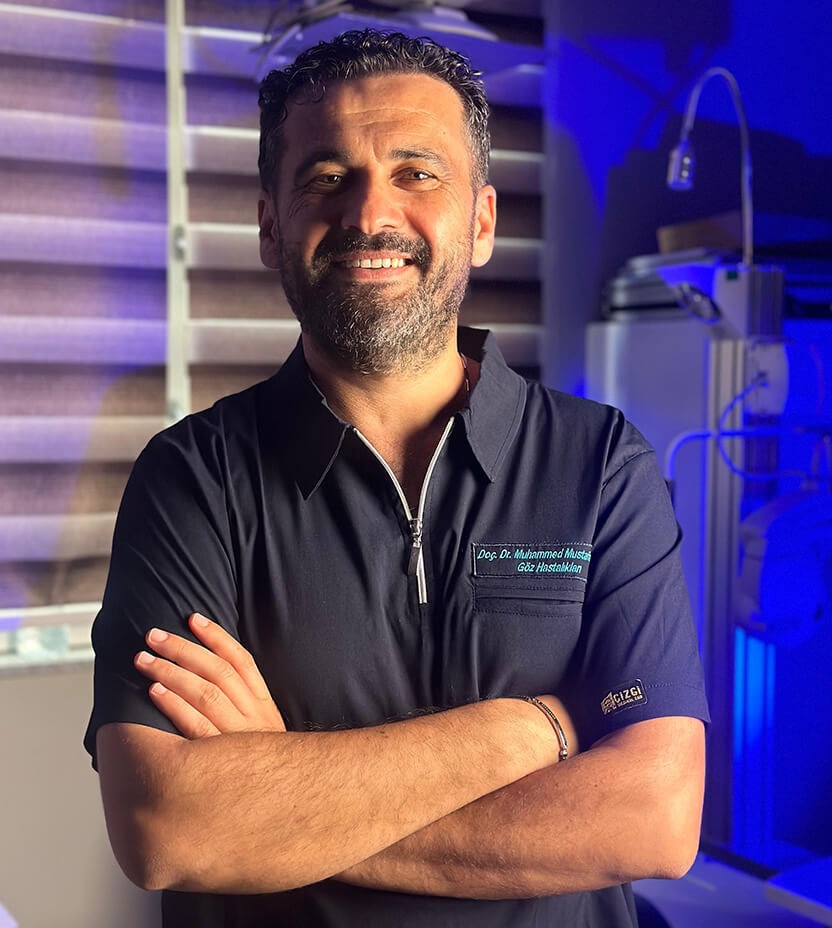
Examination and individual assessmentAssoc. Prof. Muhammed Mustafa Kurt, MD
Ophthalmologist · Atakum, Samsun
- Content preparation
- Editorial information prepared using medical sources.
- Medical review
- The content update date does not indicate that a medical review has been performed by the physician.
This article is for general information and does not replace a medical examination. Diagnosis, suitability for treatment and follow-up are determined individually after an eye examination.